
Process Modeling (BPMN)
An organisation can scale its activities if it has established robust process descriptions that are followed to create repeatable and steerable activities.
BPMN stands for Business Process Modeling Notation. It is a notation standard that is used worldwide to draw business processes. By businesses, we mean any type of organisation, including commercial companies but also government bodies and non governmental organisations.
Over the past century, various standards for process modelling have been introduced. The broad adoption of BPMN as a standard language is expected to bring consistency to the expression of general business process concepts, such as public and private processes and choreographies, as well as advanced process concepts, such as error handling and transaction compensation.
BPMN has since become a standard for modelling business processes and representing them in a Business Process Diagram (BPD). The methodology used is very similar to the activity diagrams of the Unified Modeling Language (UML). The aim of BPMN is to clarify business process management for both technical and non-technical users by using a notation that feels intuitive to non-technical users while still being capable of representing complex process semantics. The BPMN specification also forms a bridge between the graphical representation and the underlying constructs of executable languages, such as the Business Process Execution Language (BPEL).
The primary goal of BPMN is to provide a standard notation that can be understood by all stakeholders. This includes business analysts who create and refine processes, technical developers who implement those processes, and process owners who manage them. BPMN is therefore used as a common language that bridges the communication gap that often arises between the design and implementation of a business process.
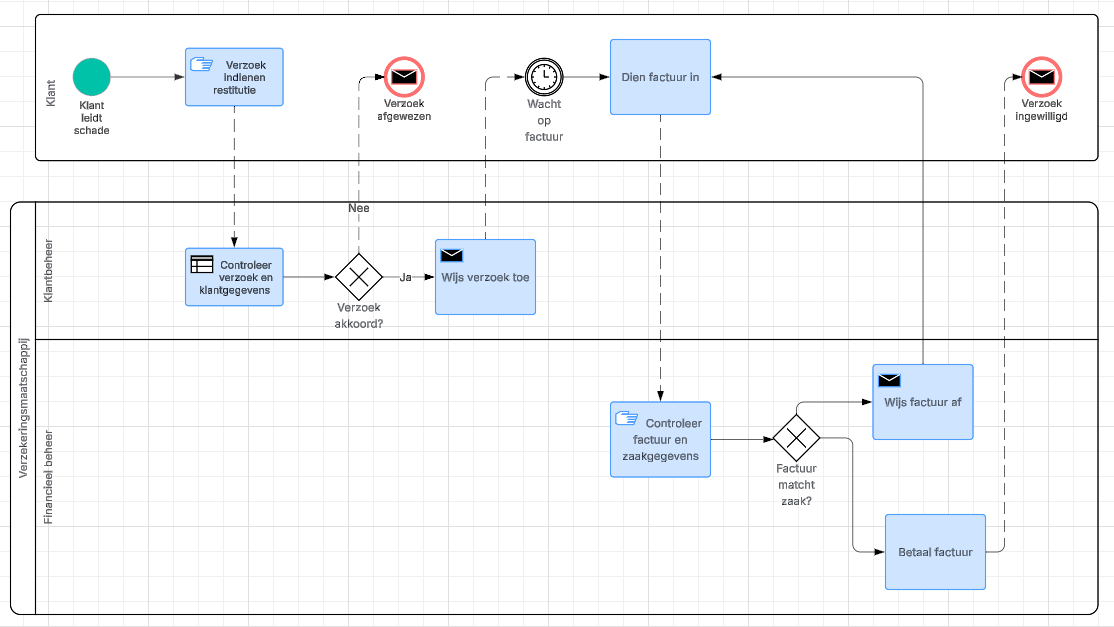
Process diagrams are not stand alone. The design of solutions for an organisation go hand in hand with various architectural designs of the organisation itself and relate to different levels of the organisation. A BPMN diagram could be related to one or more functions in corresponding [use case diagrams]. The process could be preceded or followed by other processes that make use of the same information. It might also have to follow conventions or uniform sets of data because of management models and compliance requirements.
Starting Points
- BPMN specification
- Summary at Camunda
- Architecture of processes in the largers context in organisations
Key Points
- You are able to determine when to draw a BMPN diagram
- You are able to identify the start and end events, intermediate events, tasks and gateways for the process from a case description
- You are able to draw a BPMN diagram following the specification
- You can read and explain a BPMN diagram when presented to you
- You can explan the difference between the various types of objects.