Socratic Dilemma Challenge
In groups of 4-5, you will use a Large Language Model (LLM) as a Socratic sparring partner to uncover the ethical tensions of a real-world AI deployment. You will then synthesize your findings into a 3-panel infographic and practice radical transparency by completing an "AI Nutrition Label."
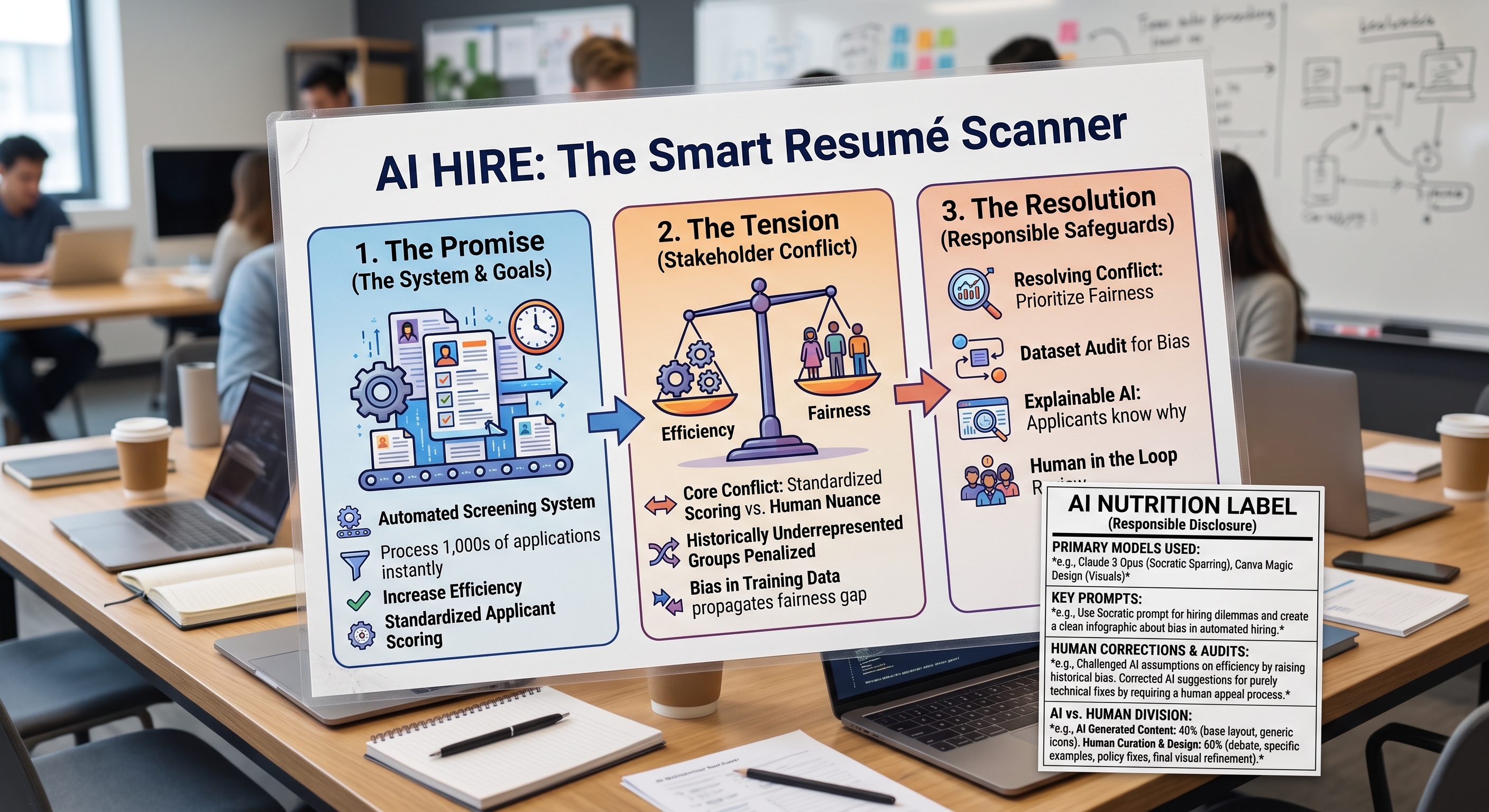
Phase 1: The Socratic Sparring Session (~15 Mins)
Before touching the AI, assign the following roles within your team to ensure you drive the discussion, rather than letting the AI do the thinking for you:
- The Lead Operator: The only person authorized to enter prompts and drive the LLM interface.
- The Devil's Advocate: Your job is to push back on the AI (and your team) by prioritizing efficiency, business goals, and technical optimization over everything else.
- The Stakeholder Champion: Your job is to constantly ask: "Who is excluded, marginalized, or harmed if this system fails?"
- The Scribe & Disclosure Lead: You take notes on the debate, track which prompts are used, and identify moments where the team overrules or corrects the AI.
The Master Prompt
The Lead Operator must copy and paste this exact prompt into your chosen LLM (e.g., ChatGPT, Claude) to begin:
 1
 2
 3
 4
 5
 6
 7
 8
 9
10
11
12
13
14
15
16
17
18
19
20
21
22
23
24
25
26
27
28
29
30
31
32
33
34
35
36
37
38
39
40
41
42
43
44
45
46
47
48
49
50
51 | You are the "Responsible AI Socratic Coach," an interactive facilitator for ICT student teams. Your job is NOT to analyze dilemmas or provide answers. You will present an unanalyzed, real-world scenario and guide our student team to debate and identify the ethical tensions ourselves.
Our team has assigned specific roles:
- The Navigator (Prompt Operator)
- The Devil's Advocate (Skeptic who challenges easy consensus)
- The Stakeholder Champion (Advocate for vulnerable/overlooked groups)
- The Scribe & Disclosure Lead (Documenter)
Throughout this conversation, you MUST explicitly address and call on these roles to drive our internal debate.
Follow this step-by-step facilitation process strictly:
1. Greet us, acknowledge our roles, and ask us to select ONE sector (or request "Random"):
- [A] Education & Campus Monitoring
- [B] Healthcare & Clinical Triage
- [C] Smart Cities & Law Enforcement
- [D] Recruitment & Workplace Productivity
- [E] Generative Media, Creative IP & Labor
- [F] Public Utilities & Automated Resource Allocation
2. Once we reply, give us a raw, factual case description (max 90 words) of a realistic AI deployment.
- DO NOT list the ethical issues, stakeholders, or solutions.
- Only describe: The organization deploying it, what the AI tool measures/automates, and the stated business/operational objective.
3. Then, prompt our team:
"Stakeholder Champion: Who benefits from this system, and who is at risk of being harmed, excluded, or overlooked? What would you point out to your team?"
(Wait for our team to respond before proceeding.)
4. When we submit our answer to Question 1:
- Provide 1 brief Socratic pushback to challenge our assumptions.
- Then prompt our team:
"Devil's Advocate: What counter-arguments or blind spots in your team's consensus need to be exposed? What is the core conflict between technical efficiency and human rights/values here?"
(Wait for our team to respond before proceeding.)
5. When we submit our answer to Question 2:
- Challenge our answer once more with a real-world friction point.
- Then prompt the entire team:
"If you were the engineering lead, what is the single hardest 'no-easy-answer' critical dilemma your team must resolve before launch?"
(Wait for our team to respond before proceeding.)
6. After we submit our critical dilemma:
- Summarize ONLY the key points of OUR OWN debate back to us in concise bullet points.
- Prompt the Scribe & Disclosure Lead to record these points and begin synthesizing them into our 3-panel infographic.
Rules:
- Never do the analysis for us.
- Keep all coach responses under 80 words.
- Always call out the relevant role in each step.
- Start now by asking for our sector choice.
- Keep a target audience of 17 year old students. Don't use too much intellectual jargon.
- Allow the team to answer clarifying questions to get to know the situation
|
Phase 2: Design the 3-Panel Infographic (~30 Mins)
Using design tools of your choice (e.g., Canva, Figma, Miro, Illustrator, or AI visual generators), visualize your team's debate across three distinct panels.
Infographic Blueprint:
- Panel 1: The Promise
- What is the AI architecture or tool?
- What is the intended business/public goal?
-
Who is the primary beneficiary?
-
Panel 2: The Tension
- Highlight the friction identified by the Stakeholder Champion and Devil's Advocate.
- Who gets left behind, misclassified, or harmed?
-
What is the core conflict (e.g., Privacy vs. Security, Efficiency vs. Fairness)?
-
Panel 3: The Resolution
- State the hard engineering trade-off your group confronted.
- Propose concrete technical and governance safeguards (e.g., algorithmic auditing, human-in-the-loop, appeal rights).
Phase 3: The AI Nutrition Label (Mandatory Disclosure)
Transparency is a core pillar of Responsible AI. Every infographic must display a completed AI Nutrition Label. You can embed this directly at the bottom of your infographic canvas or submit it as an accompanying document.
The Scribe & Disclosure Lead should fill out the following template:
 1
 2
 3
 4
 5
 6
 7
 8
 9
10
11
12
13 | ### AI Nutrition Label (Transparency & Integrity Disclosure)
* **Project Title / Dilemma Topic:** [Insert topic name]
* **Team Members & Assigned Roles:** [List names & roles]
* **Tools & Models Used:** [e.g., Claude 3.5 Sonnet, ChatGPT-4o, Canva Magic Design, Midjourney v6]
* **Primary Prompts Executed:**
1. [Paste the master Socratic prompt used]
2. [Paste any key prompts used for visual generation, layout, or copy refining]
* **Where the Team Challenged / Corrected the AI:**
- [Describe at least 1 instance where your team rejected the AI's pushback, corrected a factual/logical error, or steered the debate in a different direction during Phase 1 or 2]
* **Estimated Division of Labor:**
- AI Contribution (%): [e.g., 25% — Scenario facilitation & visual asset draft]
- Human Team Contribution (%): [e.g., 75% — Ethical debate, trade-off resolution, layout design, critique]
|
Phase 4: Pitch & Peer Audit (~10 Mins)
Prepare to defend your work.
- Lightning Pitch (90 Seconds): Present your 3-panel infographic to another group or the class. Focus on your core tension (Panel 2) and proposed safeguard (Panel 3).
- Peer Audit (60 Seconds): The reviewing team will examine your AI Nutrition Label and ask one critical question:
"Where did the AI's phrasing or suggestions influence your final conclusions, and how did you verify that choice?"
